
How to Accept Strings Containing All Vowels in Python
In this tutorial, we will learn how to program "How to Accept Strings Containing All Vowels in Python". The objective is to accept strings containing all vowels. This tutorial will guide you step by step through the process of checking whether a string contains all vowels. By the end of this tutorial, you will have a solid understanding of how to implement this solution effectively in Python, helping you strengthen your problem-solving abilities and improve your coding skills.
This topic is straightforward and easy to understand. By following the instructions provided, you will be able to complete it with ease. The program will guide you step by step through the process of accepting a string containing all vowels. So, let’s dive into the coding process!
Getting Started:
First you will have to download & install the Python IDLE's, here's the link for the Integrated Development And Learning Environment for Python https://www.python.org/downloads/.
Creating Main Function
This is the main function of the application. The following code will display a simple GUI in terminal console that will display program. To do this, simply copy and paste these blocks of code into the IDLE text editor.- # Set of all vowels
- vowels = set('aeiou')
- # MAIN LOOP
- while True:
- print("\n============= Accept Strings Containing All Vowels =============\n")
- # Input string
- s = input("Enter a string: ").strip()
- if not s:
- print("Input cannot be empty.")
- continue
- # Check if all vowels are present
- if vowels.issubset(set(s.lower())):
- print("\nTrue")
- print("The string contains all vowels.")
- else:
- print("\nFalse")
- print("The string does not contain all vowels.")
- # Try Again Option
- opt = input("\nDo you want to try again? (yes/no): ").strip().lower()
- if opt == 'no':
- print("Exiting program...")
- break
- elif opt != 'yes':
- print("Invalid choice. Exiting program...")
- break
This Python program checks whether a given string contains all vowels (a, e, i, o, u). It defines a set of vowels and converts the input string to lowercase to ensure case-insensitive comparison. Using the `issubset()` method, it verifies if all vowels are present in the string. The program outputs `True` if all vowels are found and `False` otherwise. It runs interactively, allowing users to repeat the check or exit, with input validation included.
Output:
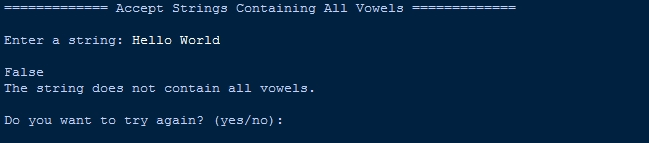
There you have it we successfully created How to Accept Strings Containing All Vowels in Python. I hope that this simple tutorial help you to what you are looking for. For more updates and tutorials just kindly visit this site. Enjoy Coding!
More Tutorials for Python Language