
How to Implement Binomial Heap in Python

In this tutorial, we will learn how to program “How to Implement a Binomial Heap in Python.” The main objective is to understand the concept of a binomial heap and how its structure is built using a collection of binomial trees. This tutorial will guide you step by step through the process of implementing a binomial heap, including key operations such as insertion, merging heaps, and finding or removing the minimum element. By the end of this tutorial, you will have a clear and practical understanding of how binomial heaps work in Python, helping you strengthen your knowledge of advanced data structures and improve your overall problem-solving and coding skills.
This topic is straightforward and easy to understand. By simply following the instructions provided, you will be able to complete it with ease. The program will guide you step by step through the process of constructing a tree and performing various operations on it, such as insertion, traversal, and manipulation of nodes. So, let’s dive into the coding process and start implementing the solution to gain a deeper understanding of tree data structures in Python!
Getting Started:
First you will have to download & install the Python IDLE's, here's the link for the Integrated Development And Learning Environment for Python https://www.python.org/downloads/.
Creating Main Function
This is the main function of the application. The following code will display a simple GUI in terminal console that will display program. To do this, simply copy and paste these blocks of code into the IDLE text editor.- class BinomialTree:
- def __init__(self, key):
- self.key = key
- self.children = []
- self.order = 0
- def add_at_end(self, tree):
- self.children.append(tree)
- self.order += 1
- class BinomialHeap:
- def __init__(self):
- self.trees = []
- def get_min(self):
- if not self.trees:
- return None
- return min(tree.key for tree in self.trees)
- def extract_min(self):
- if not self.trees:
- return None
- min_tree = min(self.trees, key=lambda t: t.key)
- self.trees.remove(min_tree)
- temp_heap = BinomialHeap()
- temp_heap.trees = min_tree.children
- self.merge(temp_heap)
- return min_tree.key
- def combine_roots(self, heap):
- self.trees.extend(heap.trees)
- self.trees.sort(key=lambda tree: tree.order)
- def merge(self, heap):
- self.combine_roots(heap)
- if not self.trees:
- return
- i = 0
- while i < len(self.trees) - 1:
- curr = self.trees[i]
- next_tree = self.trees[i + 1]
- if curr.order == next_tree.order:
- if curr.key <= next_tree.key:
- curr.add_at_end(next_tree)
- del self.trees[i + 1]
- else:
- next_tree.add_at_end(curr)
- del self.trees[i]
- else:
- i += 1
- def insert(self, key):
- temp = BinomialHeap()
- temp.trees.append(BinomialTree(key))
- self.merge(temp)
- # MAIN PROGRAM
- while True:
- print("\n================= Implement Binomial Heap =================\n")
- bheap = BinomialHeap()
- print("Menu")
- print("insert <data>")
- print("min get")
- print("min extract")
- print("quit")
- while True:
- do = input("\nWhat would you like to do? ").split()
- if not do:
- continue
- operation = do[0].lower()
- if operation == "insert":
- bheap.insert(int(do[1]))
- elif operation == "min":
- if do[1] == "get":
- print("Minimum value:", bheap.get_min())
- elif do[1] == "extract":
- print("Minimum value removed:", bheap.extract_min())
- elif operation == "quit":
- break
- else:
- print("Invalid command.")
- # Try again option
- opt = input("\nDo you want to try again? (yes/no): ").strip().lower()
- if opt == "no":
- print("Exiting program...")
- break
- elif opt != "yes":
- print("Invalid choice. Exiting program...")
- break
This program illustrates the implementation of a Binomial Heap, a specialized heap data structure composed of a collection of binomial trees that efficiently supports priority-queue operations. Each `BinomialTree` stores a key, a list of its children, and its order, which represents the number of children it has. The `BinomialHeap` class manages a list of such trees and provides core operations such as inserting a new key, retrieving the minimum element, and extracting the minimum element. Insertion is performed by creating a temporary heap with a single tree and merging it with the existing heap, while merging ensures that no two trees of the same order remain by combining them appropriately based on their keys. The `extract_min` operation removes the tree with the smallest root key, reinserts its children back into the heap, and maintains the heap’s structure. Through a menu-driven interface, the program allows users to interactively perform these operations, making it a clear and practical demonstration of how binomial heaps work internally.
Output:
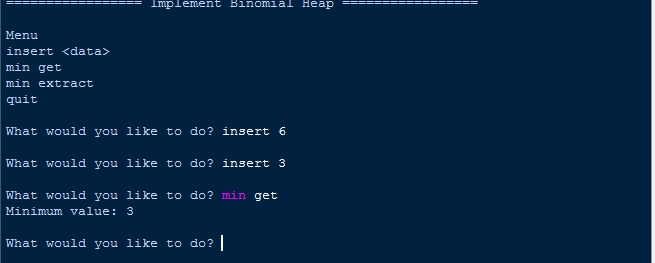
There you have it we successfully created How to Implement Binomial Heap in Python. I hope that this simple tutorial help you to what you are looking for. For more updates and tutorials just kindly visit this site. Enjoy Coding!
More Tutorials for Python Language